Real estate developers in France can be searched by city, region, project type, service area, and profile status. Review developers, agents, builders, property managers, syndic providers, commercial firms, and development-related providers before contact. Use REDH profiles to compare company details before SIREN checks, diagnostics review, or notaire-led property discussions begin.

  • List Date
  • Listing Title
  • Last Update
  • Comments
  • Author
  • Rank
  • Rate
Sort By

Remove from compare list Add to compare list Go to Compare Page
8:30 AM to 12 PM, 2 to 5:30 PM

TRADIM is a Colmar-based residential property developer in Alsace focused on new-build housing programmes on a human scale, rather than large national master-planned developments. On ...
6 Rue des Clefs, 68000 Colmar, France

Remove from compare list Add to compare list Go to Compare Page
8:30 AM to 12:30 PM, 2 to 6 PM

Promogim Alsace is best understood as the Alsace regional arm of Promogim, a long-established French residential developer focused on new-build apartments and houses rather than ...

10 Bd de Dresde, 67000 Strasbourg, France

Remove from compare list Add to compare list Go to Compare Page
9 AM to 5 PM

NaturaHOME is an Alsace-based residential developer-builder headquartered in Mulhouse, focused on new-build apartments and homes in smaller, nature-oriented residential settings rather than large national urban ...
57 Rue Victor Schoelcher, 68200 Mulhouse, France

Remove from compare list Add to compare list Go to Compare Page

Le Duo is an Alsace-based residential developer and builder focused on a very specific housing format rather than broad apartment blocks or large urban schemes. ...
46 Quai de l'Alma, 68100 Mulhouse, France

Remove from compare list Add to compare list Go to Compare Page
9 AM to 12 PM, 2 to 6 PM

LAZARD GROUP - Immobilier d’entreprise is a French commercial real estate developer and operator focused mainly on office and tertiary property, not on housing. On ...

1 All. de la Robertsau, 67000 Strasbourg, France

Remove from compare list Add to compare list Go to Compare Page
10:30 AM to 12:30 PM, 2 to 7 PM

Kaufman & Broad Strasbourg is best understood as the Strasbourg / Alsace presence of Kaufman & Broad, a major French property developer, rather than a ...
1 Quai Finkmatt, 67000 Strasbourg, France

Remove from compare list Add to compare list Go to Compare Page
9 AM to 12 PM, 1:30 to 5:30 PM

GIPA is an Alsace-based real estate developer and agency rather than only a general contractor. On its official site, the company presents itself as a ...

5 Rue Icare, 67960 Entzheim, France

Remove from compare list Add to compare list Go to Compare Page

Constructeurs d’Alsace is a Gerstheim-based residential property developer in Alsace focused on small-scale housing programmes rather than large national master-planned schemes. Its official site presents ...
17 Rue du Moulin, 67150 Gerstheim, France

Remove from compare list Add to compare list Go to Compare Page
8:45 AM to 12:15 PM, 2 to 6 PM

Cogedim Est is best understood as the Grand Est regional activity of Cogedim, a major French residential developer, rather than a small, standalone local promoter. ...
28 Av. du Rhin, 67100 Strasbourg, France

How to review real estate developers in France

Real estate developers in France can differ by city, region, company role, property type, and transaction type. A Paris developer, Nice agent, Lyon builder, or Bordeaux syndic provider may each require different checks. Start with the company profile. Review its location, website, service area, property focus, public links, and profile status. Then compare key details with official sources where needed.

For purchases or projects, users should check SIREN or SIRET data, professional-card status, property records, DDT diagnostics, VEFA terms, copropriété documents, payment terms, and current contracts.

Explore France companies by real estate focus

Real estate companies in France can work across development, sales, construction, management, investment, and advisory roles. Users should compare each provider by actual focus, not only by company name or city.

Developers may work with apartments, VEFA new-build projects, mixed-use schemes, commercial buildings, land projects, or urban renewal. Agents may focus on resale homes, rentals, luxury property, investment assets, or regional buyer support.

Some providers support property activity without owning projects directly. These may include builders, syndic providers, property managers, renovation firms, land advisers, commercial brokers, and technical consultants.

REDH categories help users narrow the search before contact. A clearer match between company focus and user need can save time when comparing homes, apartments, commercial property, new-build projects, or renovation-linked services before official checks begin.

Official checks for France real estate development company research

Before contacting real estate development companies in France, users should compare the REDH profile details with official sources where possible. These checks can help confirm the legal company, agent status, property information, planning position, and contract party.

  • Use Annuaire des entreprises when checking the legal company behind a provider. It can help users review public company information through SIREN or SIRET details. 
  • Use Infogreffe when checking RCS registration, company documents, directors, registered office details, or whether the company name matches the contract or invoice. 
  • Use the CCI professional-card search when reviewing an agent, property manager, syndic, or transaction provider. France requires a professional card for several real estate activities.
  • Use Service-Public property guidance when checking cadastre limits, diagnostics, VEFA terms, planning permissions, or notaire-led steps.

These checks support early research before payment, contract review, or legal advice.

SIREN, SIRET, and company-register checks

SIREN and SIRET checks help users confirm the legal business behind real estate companies in France. A provider may use a brand name, agency name, project name, or regional trading name, but the contract should still point to a clear legal entity.

Users should compare the REDH profile, company website, invoice, quote, mandate, and agreement with official company data. Important details may include the SIREN number, SIRET establishment number, registered office, business activity, representative details, and RCS registration where relevant.

This matters when reviewing developers, agents, builders, syndic providers, property managers, or commercial property firms. If the legal entity is unclear, users should ask for written confirmation before paying, signing, or sharing sensitive documents.

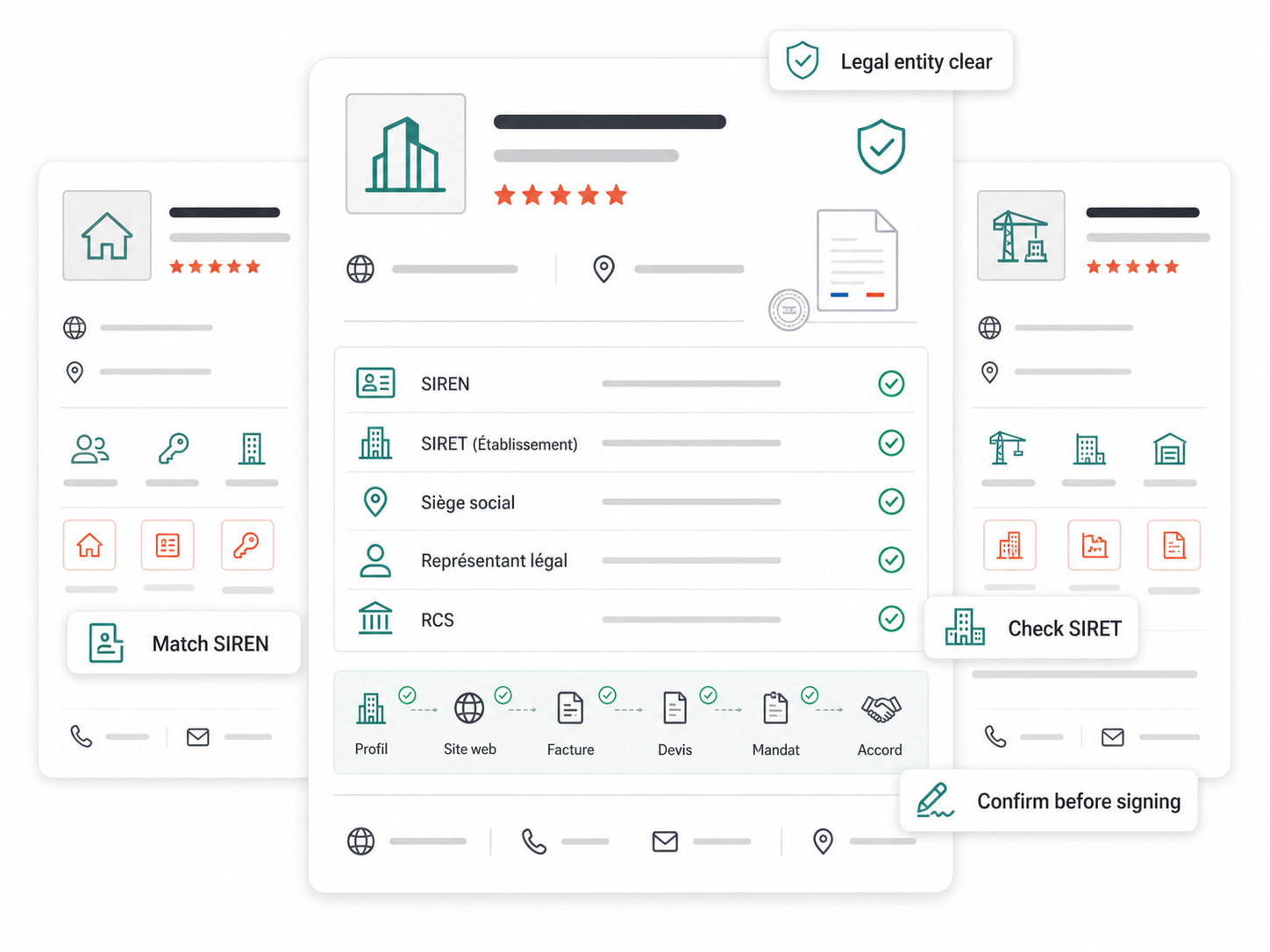
French real estate legal check graphic showing SIREN, SIRET, RCS, profile, website, invoice, mandate, and signing review cues

Carte professionnelle and agency checks

When reviewing real estate companies in France, users should check whether the provider needs a carte professionnelle for the service being offered. This is especially important for agents, property managers, syndic providers, and companies handling transactions or rental management.

Check areaWhat users should reviewWhy it matters
Card holderCompany or individual named on the cardHelps confirm who is allowed to provide the service
Activity typeTransaction, property management, syndic, or related activityThe card should match the work being offered
Card validityCurrent card period and issuing CCIExpired or unclear cards can create risk
Financial guaranteeGuarantee details where requiredImportant when the provider handles client funds
InsuranceProfessional civil-liability insuranceSupports accountability if professional errors occur
Contract partyCompany on the mandate, invoice, and payment requestHelps match the provider with official records 

A serious provider should explain its role, share professional-card details when relevant, and confirm how client funds are handled. REDH profiles help users review the company first, while CCI checks, contracts, and notaire guidance should support final decisions.

Cadastre, property record, and notaire checks

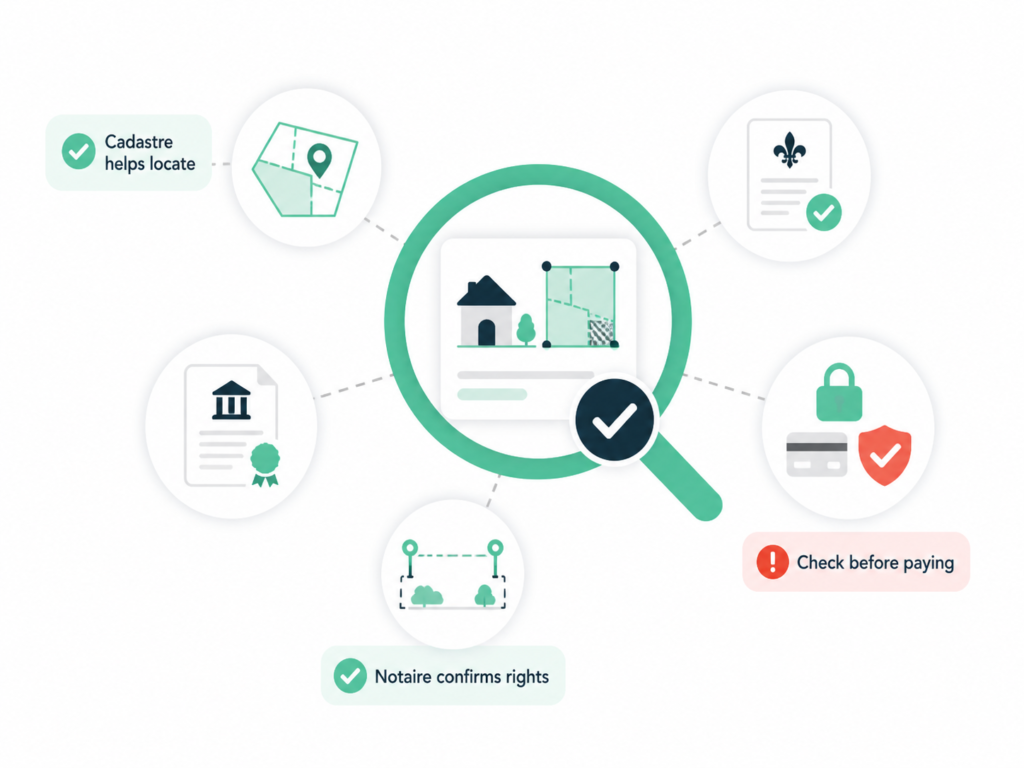
Property checks in France should not rely on one source alone. The cadastre can help users identify a parcel, location, and tax-related property details, but it does not prove ownership or final legal rights.

Users should ask the notaire or legal adviser to confirm ownership, registered rights, charges, boundaries, easements, and any conditions linked to the sale. This matters for rural homes, apartments, land, renovation projects, and properties with shared access.

REDH profiles help users review the company first, while property-specific checks should happen through the notaire process before signing or paying.

France property check infographic showing cadastre map, notaire review, ownership checks, and payment warnings before paying.

VEFA and off-plan developer checks

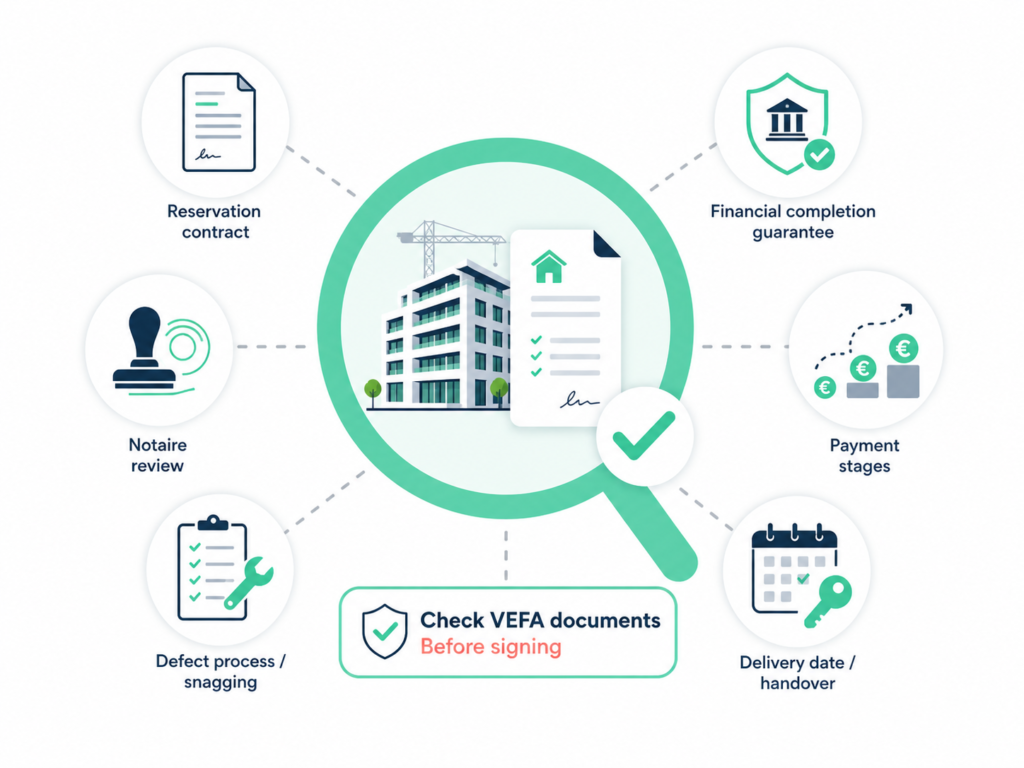
VEFA and off-plan purchases in France need careful document review before users rely on delivery promises or sales material. Users should ask about the reservation contract, financial completion guarantee, payment stages, delivery date, technical description, and defect process. Service-Public explains VEFA buyer rights and guarantees, including how the buyer becomes the owner as construction progresses. A clear developer should also explain what happens if the handover is delayed or the work does not match the agreed description. REDH profiles help users review the developer first, while VEFA contracts should still be checked through the notaire process before signing.

France VEFA infographic showing reservation contract, payment stages, notaire review, handover checks before signing safely.

French DDT, DPE, and property-condition checks

Property-condition checks in France often start with the Dossier de Diagnostic Technique, or DDT. Service-Public says these diagnostics must be grouped into the DDT and attached to the promise to sell or deed of sale. The file can include energy performance, asbestos, lead, termites, gas, electricity, sewage, risk status, noise, and other checks depending on the property.

Users should review the DPE rating, old-building risks, electrical or gas notes, asbestos or lead findings, termite exposure, septic-tank condition, and natural-risk information before relying on the asking price alone.

These checks matter for older homes, rural properties, apartments, renovation projects, and rentals. REDH profiles help users review the company first, while property condition should still be checked through the DDT, notaire process, and qualified advice before signing.

Copropriété and apartment-building checks in France

Apartment purchases in France often involve a copropriété, or co-ownership building. Users should review shared-building documents before judging the unit by price, location, or photos alone.

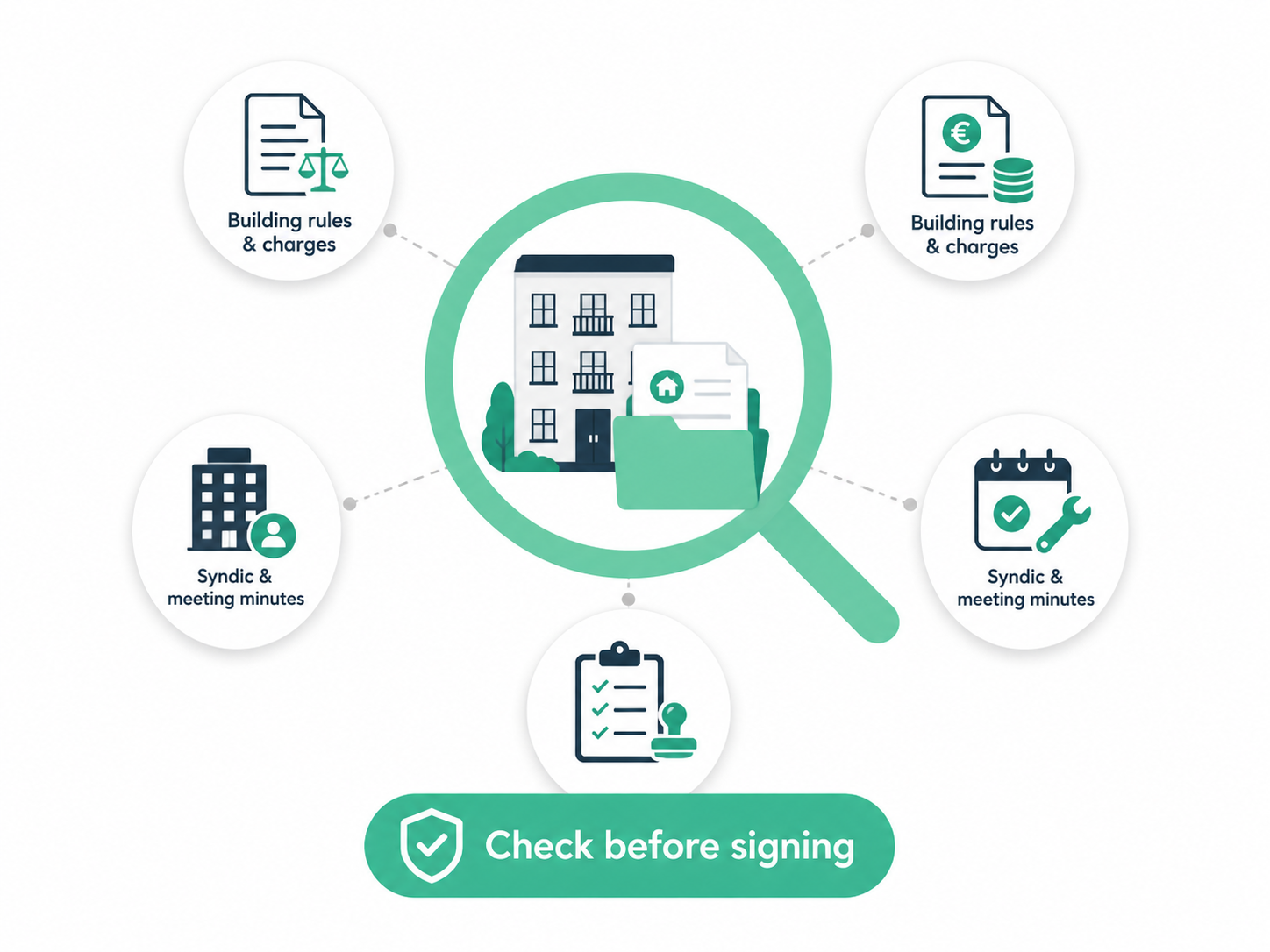
Important checks include the règlement de copropriété, building rules, service charges, syndic details, meeting minutes, voted works, unpaid charges, and planned repairs. These documents can show whether the building has cost pressure, disputes, renovation needs, or restrictions that affect daily use.

This matters for city apartments, investment flats, mixed-use buildings, and older properties with shared systems. A low unit price may become less attractive if major works are already planned or the syndic records show unresolved issues.

REDH profiles help users review the company, agent, developer, or property manager first. Copropriété documents should still be reviewed through the notaire process before signing, paying, or accepting final terms.

France copropriete check infographic with apartment, building rules, syndic records, charges, and notaire review before sale

Agent, contract, and payment warning signs

When reviewing real estate companies in France, users should be careful if a provider pushes for fast payment before the notaire, DDT, copropriété documents, or contract terms are clear. A serious provider should explain its legal role, professional-card status, payment route, and document process before asking for commitment.

Warning signs may include pressure to sign quickly, missing DDT files, unclear carte professionnelle details, payment requests outside the notaire process, weak VEFA guarantees, no copropriété documents, or vague answers about defects, diagnostics, service charges, or planning permission.

Users should also question offers where the agent, seller, developer, invoice name, and payment recipient do not match. Written terms should explain what is being sold, who is responsible, which documents are available, and what happens if the transaction does not move forward.

REDH profiles help users review the company first. Final decisions should depend on current records, notaire guidance, legal review, and documents that match the property and provider.

How REDH supports a clearer France shortlist

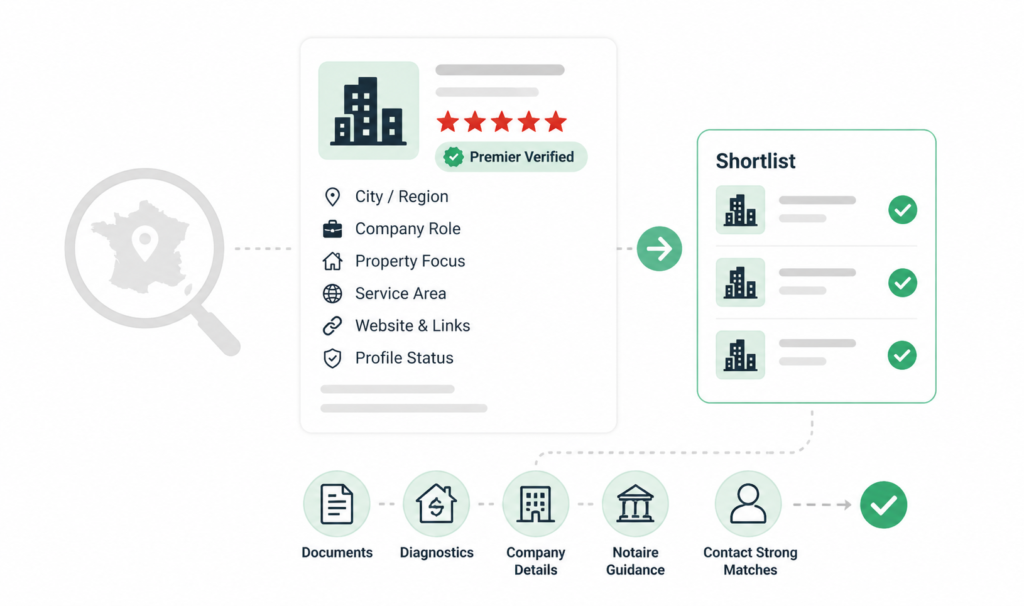
REDH helps users move from broad search results to a more useful shortlist of real estate companies in France. Instead of comparing providers only by name, users can review city, region, company role, property focus, service area, website details, public links, and profile status.

This matters because French providers may have different roles. Some develop VEFA projects. Others sell homes, manage copropriété buildings, handle renovations, support rentals, or advise on commercial assets.

After building a shortlist, users can contact stronger matches and ask for documents, diagnostics, company details, and notaire guidance.

France real estate shortlist graphic showing profile status, city, roles, property focus, links, and review steps for clients

Get your France company profile listed

Real estate and development-related companies in France can create or claim a REDH profile to make their business easier to review.

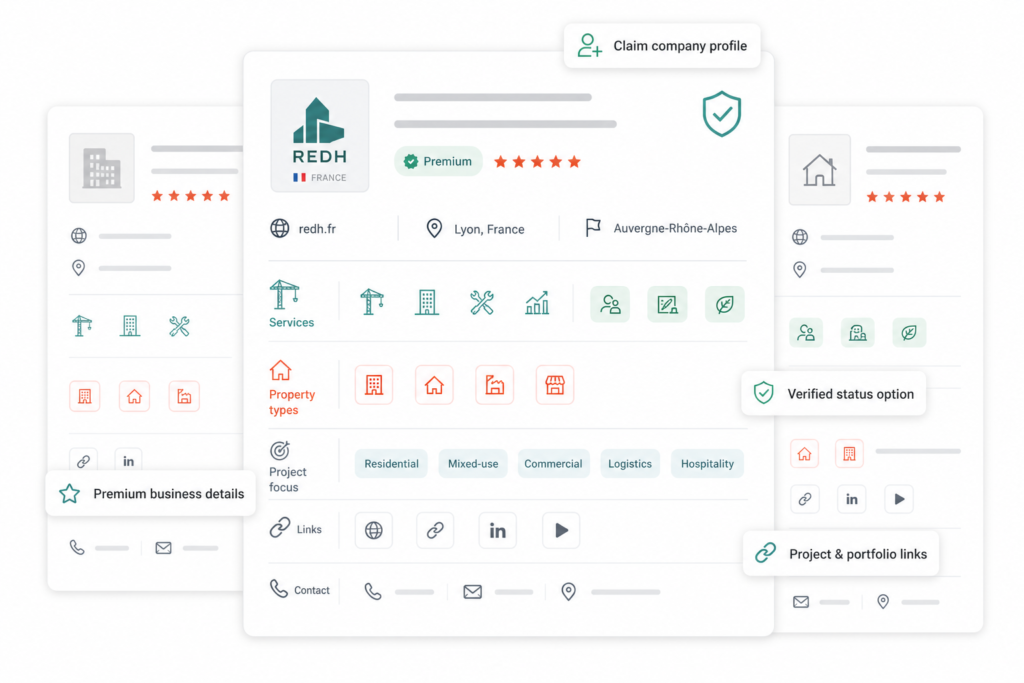
A profile can show company name, website, city, region, service areas, property types, project focus, categories, public links, and contact details.

France companies can also choose a premium profile with added business information, legal details, team size, portfolio URLs, and project links, or apply for verified status if stronger proof signals are needed.

France REDH profile graphic showing company claim, premium details, verified status, project links, and contact info clearly.

Browse real estate developers in France

Use this page to explore real estate developers, agents, builders, property managers, syndic providers, commercial property firms, and development-related companies across France.

Each profile can help users compare city, region, company role, property focus, service area, public links, and profile status. Users can open profiles that match their search, then continue with SIREN or SIRET checks, carte professionnelle review, DDT diagnostics, copropriété documents, notaire guidance, contract terms, and direct company questions before making decisions.

Frequently asked questions about real estate developers in France

Real estate developers in France can be reviewed by city, region, property focus, profile status, and official company details.

What types of real estate companies in France can I find?

You can review developers, agents, builders, property managers, syndic providers, commercial property firms, renovation companies, land advisers, and development-related providers. Each profile may show city, region, service area, property focus, website details, public links, and profile status.

Listed means the company appears on REDH with basic public or submitted profile information. This may include company name, website, city, region, category, service area, property focus, and contact details. Listed status does not mean the company has completed REDH verification.

Verified means the company completed REDH’s added review process based on submitted details, available proof, public information, and company-related evidence reviewed at the time. Verified status can support early research, but users should still check records, diagnostics, contracts, and legal details.

Yes. SIREN and SIRET details can help users confirm the legal company behind a provider. REDH profiles support early company research, while official company data, contracts, invoices, and notaire guidance should be checked separately.

Yes. A French real estate or development-related company can request to claim its REDH profile. REDH may ask for proof that the person is authorised to manage the company information before profile changes are approved.

Build a clearer company profile on REDH

Choose a listed profile for basic visibility, or apply for verification if your company wants stronger proof signals.