Browse real estate company locations across countries and continents, compare local developers, builders, and property firms, then move from broad search to stronger market-specific shortlists before contact or outreach begins.

Find real estate and development companies by location

Real estate work is local, even when companies operate across borders. A developer in the United Kingdom may follow a different process than a builder in Thailand, a property firm in Mexico, or a development company in the United Arab Emirates.

That is why location matters during early company research.

Real Estate Developers Hub helps users explore real estate developers, builders, property firms, and development-related companies by country, region, and market focus. Instead of starting with a random search result, users can begin with a clearer location path.

Each location page can help users understand which companies are active in that market, what type of work they handle, and what public profile details are available. This makes it easier to move from a wide search into a better shortlist.

The goal is simple: help users compare companies with more structure before direct contact begins.

Browse companies across different markets

Real Estate Developers Hub includes companies from multiple countries and regions. Users can explore markets across Europe, Asia, the Middle East, North America, Latin America, and other active real estate regions.

This can support many types of searches. A buyer may want to compare residential developers in one country. An investor may look for firms active in commercial or mixed-use projects. A project team may need builders, consultants, construction partners, or property service providers in a specific market.

Location pages help users start with the right market first.

They can then review company profiles by role, project type, service area, property focus, and profile status. This makes the research process less scattered and more useful.

Why location-based research matters

Real estate companies do not all work in the same way. Local rules, buyer protection systems, land records, permits, contracts, payment practices, and project delivery standards can change from country to country.

What changes by locationWhy users should check it
Legal rulesTo understand what documents, contracts, or approvals may be needed
Land and ownership recordsTo confirm whether the company or project details match public records
Payment practicesTo see whether payment requests follow local project or contract stages
Buyer protection systemsTo know what safeguards may exist before money is sent
Project delivery standardsTo ask better questions about timelines, handover, and defects

A company may look strong online, but users still need to know where it works, what it handles, and whether its profile gives enough context for the next step.

Location-based research helps users ask better questions earlier. Before contacting a company, users can check profile details, public links, business focus, and available proof signals. This does not replace legal, financial, or technical review. It helps users avoid starting from a weak or unclear point.

That matters when projects involve large budgets, long timelines, and serious commitments.

What users can compare on location pages

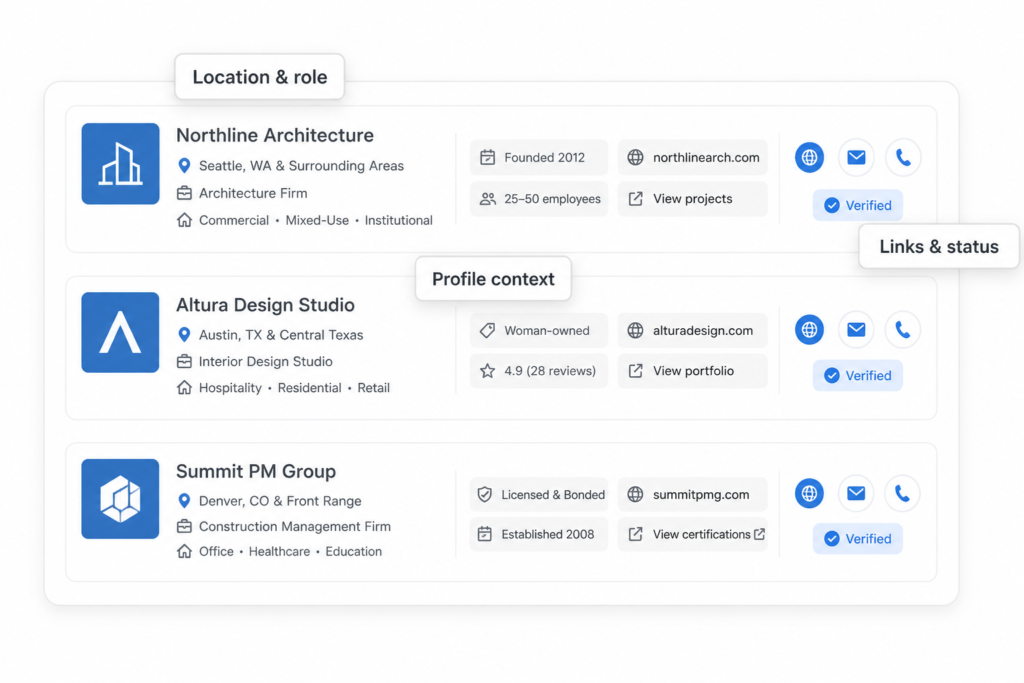
Each location page can help users review companies connected to that market. The exact details may vary by profile, but users may be able to compare:

  • Company name and public profile details
  • Country, city, or service area
  • Company role or category
  • Property types handled
  • Project focus or business focus
  • Website and public links
  • Contact points where available
  • Listed or verified profile status
Location page UI showing company names, cities, roles, property types, contact links, and listed or verified badges clearly.

These details help users understand the company before outreach begins.

For example, one firm may focus on new residential buildings. Another may support commercial assets, property management, construction delivery, or investment advisory. A third company may work across several property types.

A location page helps users separate these roles before deeper review starts.

Listed and verified company profiles

Some profiles on REDH are listed. This means the company has a structured profile with public business details that users can review during early research.

Some companies may also apply for verified status. Verified profiles go through an added review process based on submitted details, public information, project evidence, website checks, identity signals, and other proof points available at the time of review.

Verified status does not guarantee future delivery, legal safety, financial strength, or project success. Real estate decisions still require direct checks, document review, qualified advice, and current confirmation. However, verified status can help users see which companies have provided stronger review signals inside the platform.

Use location pages before building a shortlist

A shortlist should not be built from company names alone. Use location pages to compare what each firm does, where it works, which property types it covers, and how much profile context is available before contact. This is useful when reviewing developers, builders, and property firms across different countries. Stronger matches usually show clear service areas, relevant project focus, active public links, useful business details, and stronger proof signals. After narrowing options, users can ask selected companies for current documents, project information, legal details, timelines, pricing, references, and local evidence. REDH supports early research before qualified review and final checks.

Company comparison UI showing firm names, service areas, roles, profile details, public links, and verified badges by market.

For companies active in multiple locations

Real estate and development companies can also use location pages to improve how users discover them. A company profile can show where the business operates, what type of projects it handles, which clients it serves, and which contact details are available. This helps users understand whether the company may match their needs before starting a conversation. Companies working across several markets can use their profile to present service areas more clearly.

Those that want stronger trust signals can apply for verification. Approved companies may receive a verified badge, an upgraded profile, and verification materials that can support their credibility outside the platform.

Start with a location, then compare companies

Use the location pages to begin your research by market. Choose a country or region, review available company profiles, and compare firms based on the details that matter for early decisions. You can explore developers, builders, property firms, construction-related companies, and other real estate service providers in different markets.

Start broad. Then narrow your search by location, role, property type, service area, and profile status. That gives you a clearer way to move from search to shortlist before direct contact begins.