
Real Estate Developers Hub helps users review real estate developers, property companies, and development-related firms before starting contact.
Our research methodology explains how we collect company information, review profile details, handle verification applications, and separate listed profiles from verified profiles. The goal is to give users clearer company context before project talks, legal checks, financial reviews, or partnership discussions begin.
Real estate decisions can involve large budgets, long timelines, public permits, private documents, ownership structures, project claims, and many different stakeholders. A company profile should make early research easier. It should help users understand what a company does, where it works, what type of projects it handles, and what level of review its profile has received.
REDH uses public information, company submissions, profile claim requests, and verification materials to build and improve company profiles. Some profiles may only include basic information. Other profiles may contain more detailed information if the company has claimed the profile or completed a verification review.
Our methodology is built around one simple principle: profile status must be clear. A listed company and a verified company should never look the same to users.
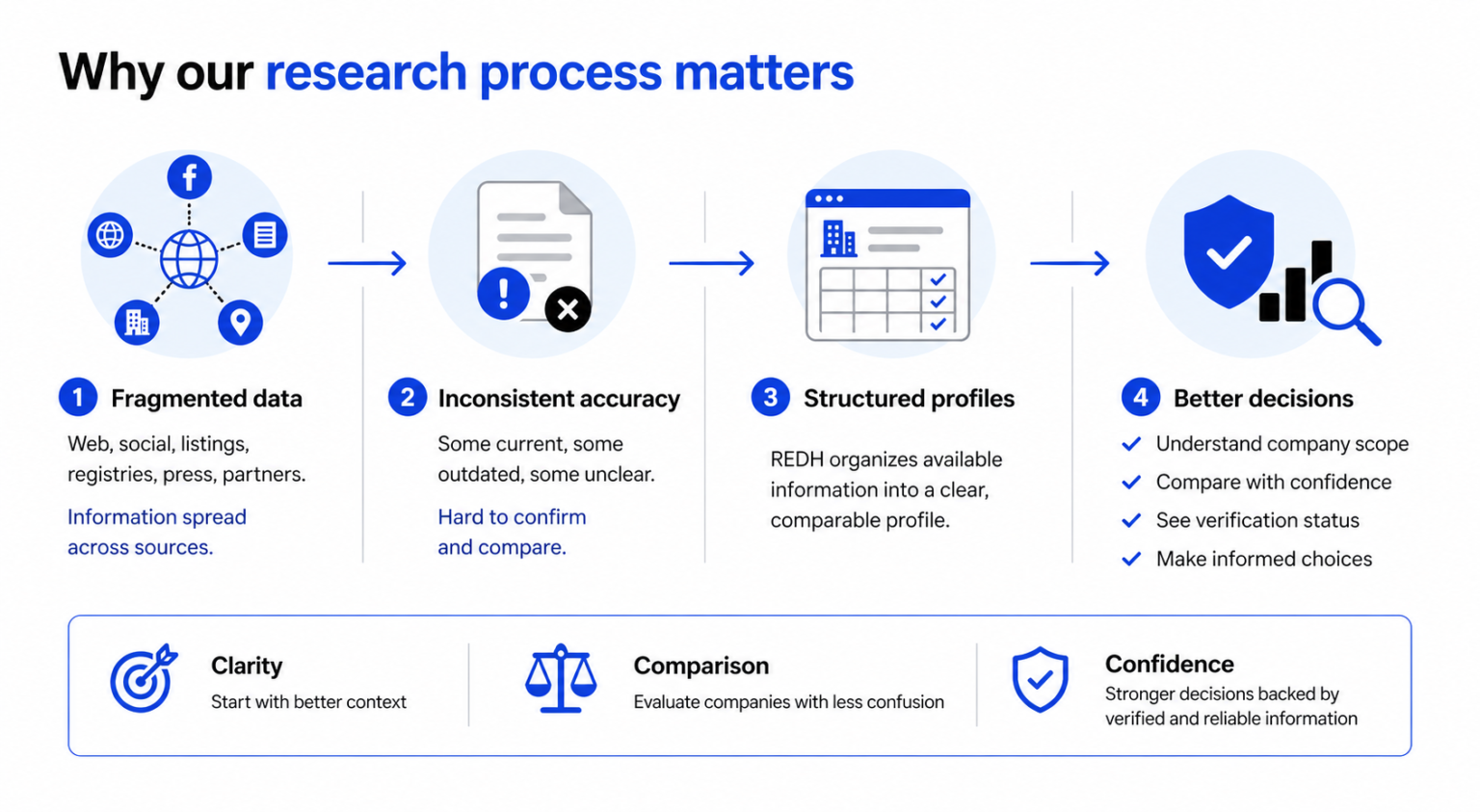
Why our research process matters
Real estate company research can be difficult because useful information is often spread across many places. A company may have a website, social media accounts, project pages, property listings, registry records, press mentions, and partner references. Some details may be current. Some may be outdated. Some may be hard to confirm without speaking to the company directly.
REDH brings available company information into a structured profile format. This helps users compare companies with less confusion.
A strong profile can show:
- where the company works
- what type of real estate it focuses on
- which services or project roles it may provide
- what public contact points are available
- which website or social pages are connected to the company
- whether the company is listed or verified
- what kind of information has been reviewed
This process helps users start with a better context. It also gives companies a clearer way to present their work, correct public details, and apply for verification when they want stronger proof signals.
How company profiles are created
REDH creates profiles through public research, company submissions, direct profile creation, and profile claim requests. When a profile is added or updated, we review available sources to understand what the company does, where it works, and which project types it presents publicly. A basic profile may include company name, website, location, category, property types, service areas, project focus, social links, short description, and profile status.
Claimed or verified profiles may include deeper details, such as legal company name, business registration data, portfolio materials, team size, working hours, and project evidence.
Public information can change, so users should treat each profile as a research starting point. Before making a serious decision, users should still contact the company directly, review current documents, and seek professional advice where needed.
| Information area | What REDH may review | Why it matters |
|---|---|---|
| Company identity | Company name, brand name, legal name | Helps users understand who the profile represents |
| Website | Official website, domain, contact page | Helps connect the profile to a real online presence |
| Location | Country, city, address, service market | Helps users search by market and operating area |
| Company category | Developer, property firm, builder, related provider | Helps users compare similar company types |
| Property focus | Residential, commercial, mixed-use, hospitality, land, industrial | Helps users match companies to project needs |
| Service area | Local, regional, national, international | Helps users understand where the company may operate |
| Project information | Project pages, portfolio, active developments | Helps users review visible work and market focus |
| Public links | Social media, maps, business pages | Helps users check wider public presence |
| Profile status | Listed or Verified | Helps users understand the review level |
| Submitted details | Documents, portfolio files, business data | Used when companies claim profiles or apply for verification |
How REDH uses public information
REDH uses public information to make each profile easier to understand and compare. We may review company websites, project pages, public registries, social profiles, maps, news mentions, and portfolio materials. These sources help us identify location, company focus, service areas, contact points, and visible project activity. When details are unclear, we avoid strong claims. Profile text should reflect what can be supported, not what sounds impressive or useful for promotion. This protects users and serious companies from confusing profile claims.
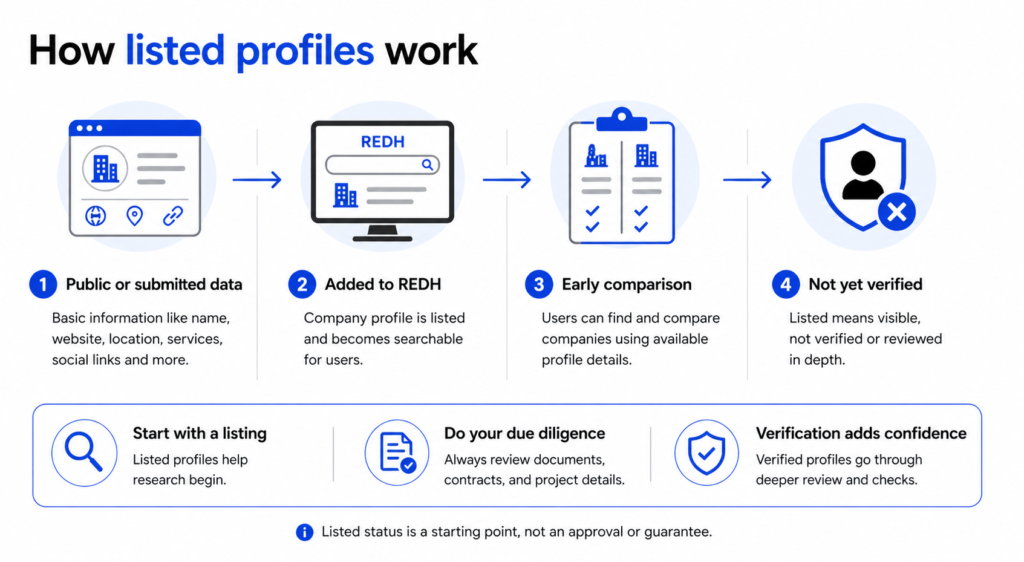
How listed profiles work
A listed profile means a company appears on REDH with basic public or submitted information. This may include its name, website, location, company type, property focus, service area, social links, and profile description. Listed status helps users find and compare companies during early research. It does not mean the company has completed verification or passed a deeper review. Some listed profiles may be added through public research, while others may come from company submissions or claim requests. Users should treat listed profiles as a starting point and continue checking current documents, contracts, and project details before making decisions.
How verification applications work
A company can apply for verified status after creating or claiming a profile. The review helps REDH understand whether the company details are supported by available proof. During review, we may ask for:
- Legal company details
- Business registration information
- Website and contact details
- Project evidence
- Portfolio materials
- Public records
- Service areas
- Property types covered
These materials help our team compare submitted information with public sources. If details are unclear, incomplete, or inconsistent, REDH may ask for more information before making a decision.
Payment does not guarantee verified status. A company receives the verified badge only after the required review is completed and approved. Verified status reflects the information reviewed at the time of assessment, so users should still complete their own checks before making serious decisions.
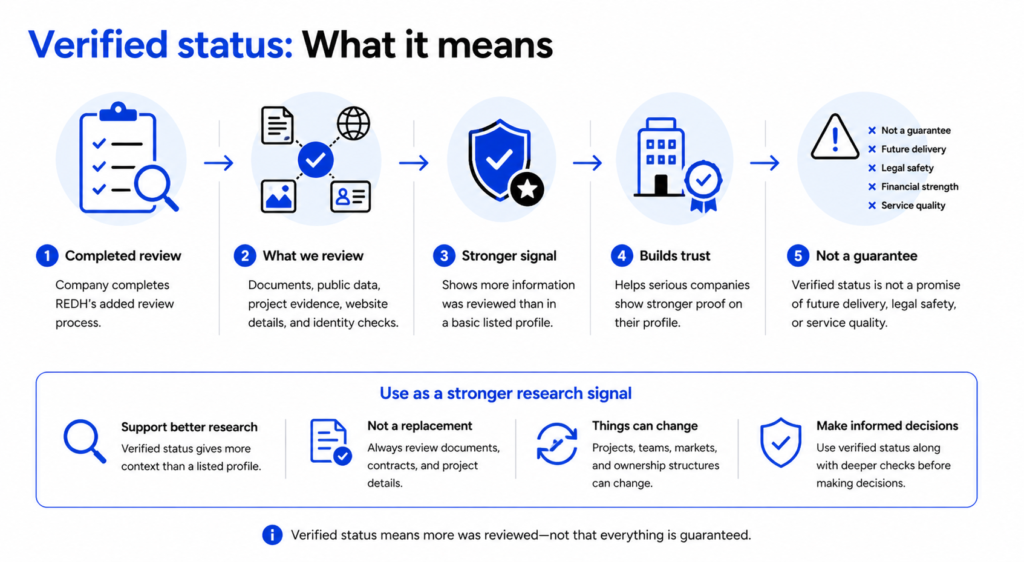
What verified status means
Verified status means a company completed REDH’s added review process. The review may include submitted documents, public information, project evidence, website details, and company identity checks. This status helps users see that more information was reviewed than in a basic listed profile. It can also help serious companies show stronger proof on their profile. Still, verified status is not a project guarantee. It does not promise future delivery, legal safety, financial strength, or service quality. Real estate decisions can change as projects, teams, markets, and ownership structures change. Users should use verified status as a stronger research signal before deeper checks.
How we handle profile updates
Company information can change after a profile is created. A business may launch new projects, move offices, update its website, change service areas, or stop using old contact details. REDH may update profiles when new public information is found, when a company submits changes, or when a profile is claimed by an authorized representative.
Users and company representatives can contact REDH if a profile looks incorrect, outdated, incomplete, or misleading. We may review the request, ask for supporting proof, and update the profile when enough information is available. Some records may stay in our system for review history, fraud prevention, dispute handling, or platform integrity.

How we manage limits and uncertainty
REDH aims to make company research clearer, but every profile has limits. Public sources can be outdated, incomplete, or written for promotion. Some companies work through related brands, local partners, project companies, or changing ownership structures. Because of this, our team avoids claims that sound stronger than the evidence we can review.
When information is limited, we may use careful wording and keep the profile focused on visible facts. We may say what a company appears to do, where it presents active work, or which services are shown through public materials. We do not treat missing information as proof of a problem. We also do not treat public claims as final proof without support. Users should read REDH profiles as a starting point for research, then continue with direct contact, current documents, legal review, financial checks, and project-specific questions before making a serious decision. This helps reduce confusion while keeping responsibility with the people making the final choice.
How users should read REDH profiles
Users should treat REDH profiles as a research starting point, not a final decision tool. A profile can help users understand a company’s visible activity, location, project focus, service area, public links, and profile status before contact begins.
Before making a serious decision, users should still review official documents, contracts, payment terms, ownership details, permits, timelines, references, and local requirements. REDH helps users ask better questions earlier, but final checks should happen directly with the company and qualified advisers when needed.
How companies can support better research
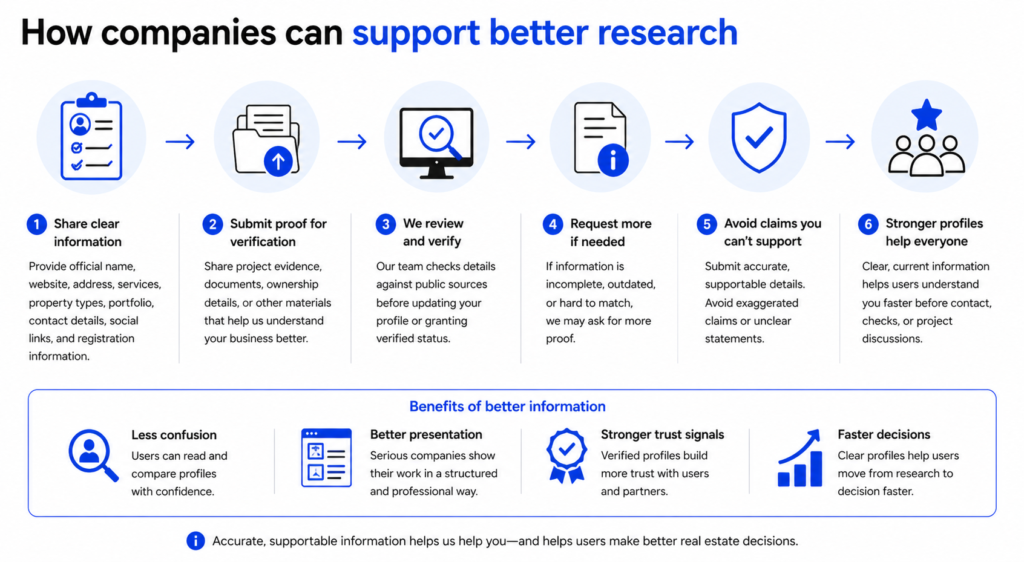
Companies can improve profile quality by sharing clear, current, and supportable information with REDH. This may include the official company name, website, business address, service areas, property types covered, project portfolio, public contact details, official social links, and business registration information. Companies applying for verification may also provide active project evidence, submitted documents, ownership details, or other materials that help our team understand the business better.
Better information helps users read profiles with less confusion. It also helps serious companies present their work in a more structured way. REDH may review submitted details against public sources before updating a profile or granting verified status. If information is incomplete, outdated, or hard to match, we may ask for more proof. Companies should avoid exaggerated claims and submit details they can support. A stronger profile should help users understand the company faster before direct contact, legal checks, or project talks begin.
How REDH protects profile clarity
REDH protects profile clarity by avoiding claims that cannot be supported. Profile text should explain what a company does, where it works, and what information is available. It should not use empty praise, unclear labels, or strong claims without proof. We may edit descriptions, remove unsupported wording, or ask for more details when needed. This keeps profiles useful for users and fair for companies. Clear profile language also helps users compare firms without confusing listed status with verified reviews.
Our commitment to clear profile status
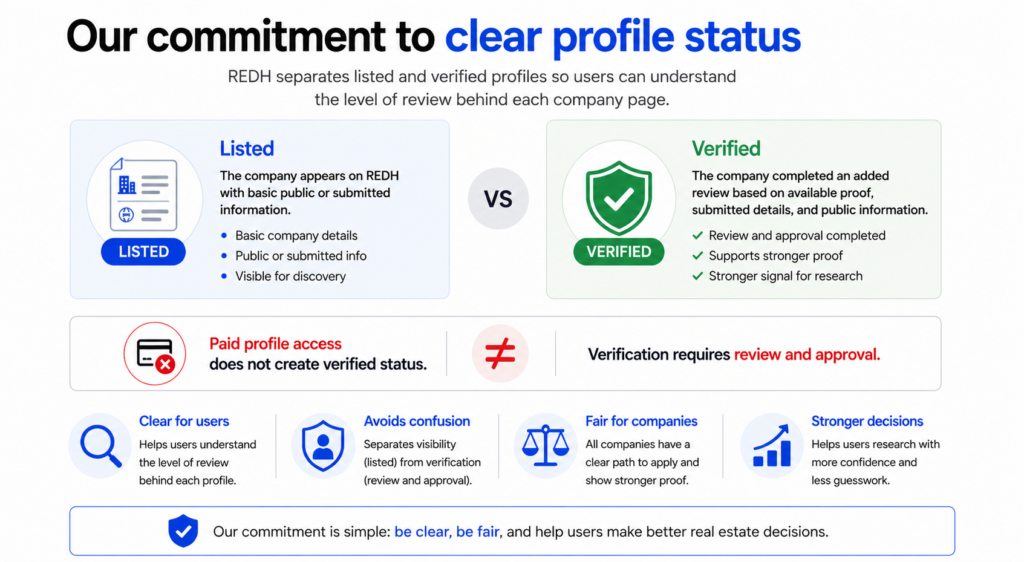
REDH separates listed and verified profiles so users can understand the level of review behind each company page. Listed means the company appears on the platform with basic public or submitted information. Verified means the company completed an added review based on available proof, submitted details, and public information.
Paid profile access does not create verified status. Verification requires review and approval. This clear separation helps users avoid confusing visibility with verification. It also gives companies a fair path to show stronger proof when they are ready to apply for review.
Contact REDH about profile research
If you have a question about a company profile, verification status, profile correction, or research process, contact Real Estate Developers Hub.
Email: info@realestatedevelopershub.com
Website: https://realestatedevelopershub.com
REDH reviews profile-related messages and may update information when enough support is available.